Endpoint360 replaces the aging WinForms console with a fast, browser-native cockpit over your entire Configuration Manager estate: devices, CMPivot, run scripts, software, patching, health, and compliance, in one place. Installs beside your existing site. No new infrastructure.
Runs on your Windows Server · no cloud dependency · air-gap ready · Kerberos SSO
Exploits are weaponized in hours; change boards meet on Thursdays. Endpoint360 closes that gap. Vulnerability feeds become governed remediation campaigns that score, deploy, verify, and document themselves. Your team keeps exactly one job: the decision.
CISA KEV & BOD 22-01 clocks · NIST 800-53 evidence · dual-auth, distinct humans
Estate-wide client health, infrastructure monitoring, and deployment SLAs, with anomaly agents that turn a spike into a governed incident and Knowledge Chat answering questions grounded in your own environment. AI is optional, off by default, and provider-pluggable, including IL4/IL5 paths.
Client health · infrastructure monitor · Knowledge Chat · anomaly agents · SLA tracking
Most consoles show you the problem. Endpoint360 runs the whole loop, and writes the evidence trail your assessor asks for, while it happens.
The feed ingests (connected fetch or offline bundle, your posture decides), reconciles IAVA → CVE → KB, and measures exactly who is exposed. Live, against your site database.
By the time your team sits down, Vanguard has already done everything except decide.
AdminService, direct SQL, CMPivot and the fast channel: one console over all of ConfigMgr. Vulnerability reconciliation maps IAVA → CVE → KB → deployment gap in seconds, a chain DoD admins have walked by hand for twenty years.
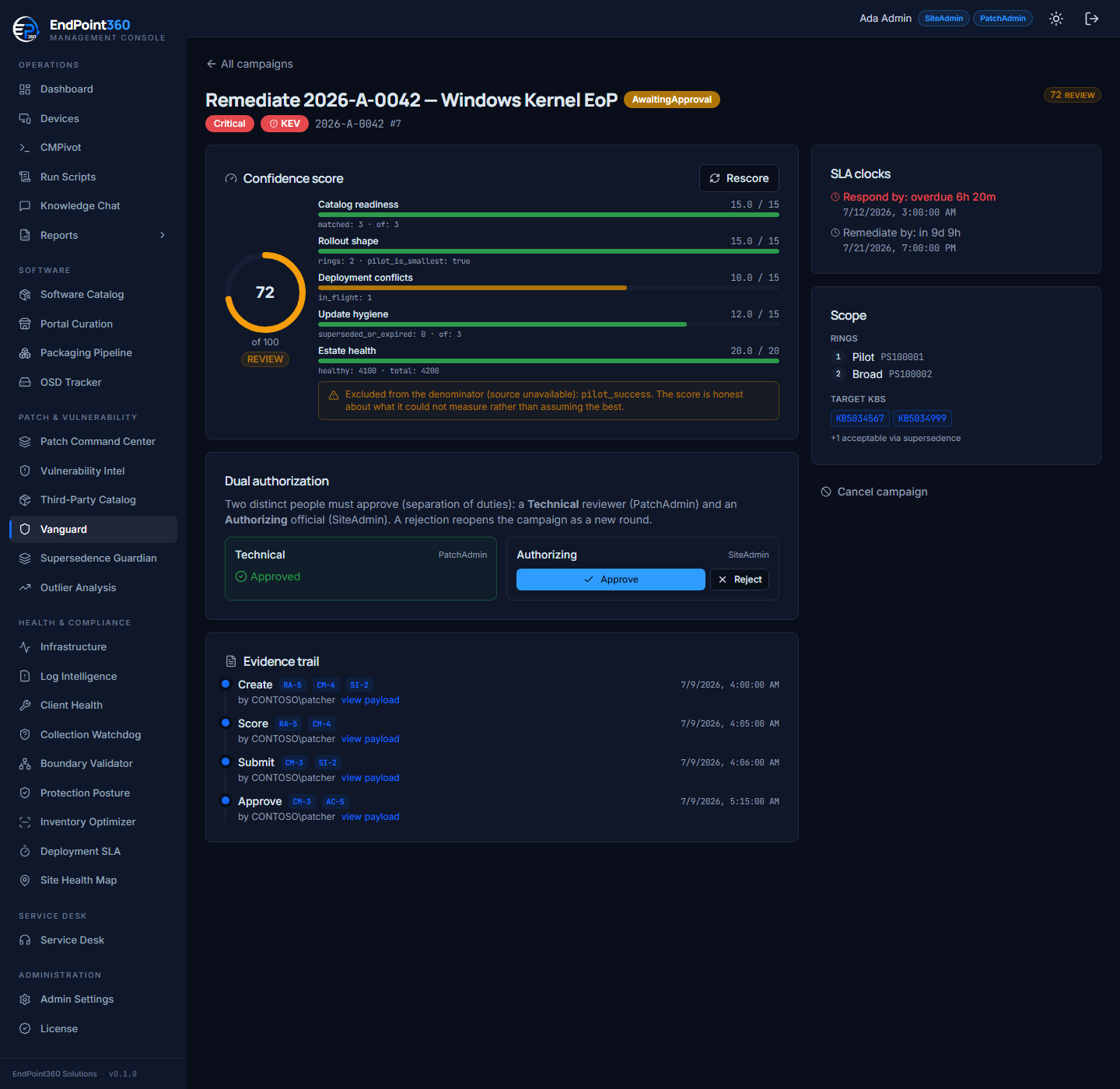
The Ready / Review / Blocked confidence score is computed from your own live telemetry: catalog readiness, update hygiene, deployment conflicts, client-estate health, and pilot results, with an honest denominator that discloses what it couldn't measure.
Every gate stamps the NIST 800-53 controls it satisfies into an assessor-readable trail: who approved, what the exposure was, when each ring promoted, and the measured compliance that closed it. Audit questions become database queries.
Attackers are about to move at machine speed. Vanguard is patch governance built to answer at the same speed: automated testing, scoring, and ring promotion on a 72-hour clock, with a human keeping the one decision that matters. Do less. Ship faster. Carry less risk.
A Blocked verdict stops execution until a named human accepts the risk in writing. Approval is always human. That line is never crossed.
In 30 days: overnight problems surfaced before your team logs in, support actions safely delegated to the help desk, recurring client repairs automated, and the admin hours you got back shown on a dashboard. No ConfigMgr replacement. No new endpoint agent. One annual subscription, three editions.
Everything the native console does, done better in a browser. If ConfigMgr can show it or do it today, Core makes it faster, web-native, and audited.
Built for the ConfigMgr admins keeping systems management alive. Endpoint360 works for your team, not instead of it: it clears the repetitive work off your plate, closes tickets faster, and makes everything your team delivers visible to leadership. Compare the price to escalations, weekend patch work, and audit scrambles, not to other software.
The concepts that exist nowhere in ConfigMgr. The full AI layer and machine-speed patch governance, for estates that answer to an auditor, a cyber insurer, a security framework, or a government mandate.
The license metric is an active managed endpoint: a device with Configuration Manager activity in the last 45 days, excluding approved lab and test collections. The product measures it for you from the site database. Overage is handled with a warning and a renewal true-up, never a hard operational stop.
Modernizing ConfigMgr should not mean taking on a new attack surface, a new identity system, or a vendor you have to take on faith. Endpoint360 is deliberately the opposite.
The payback framing that matters: one reliably automated 10-hour-per-week workflow hands your senior admins back roughly $24,000 a year of their time for the work that actually needs them. Endpoint360 pays for itself by making the team you already have more effective, never by shrinking it. That is a case your admins can take to leadership with a straight face.
Ahead of general availability, we are selecting a small first cohort of production ConfigMgr shops as Founding Design Partners for early access. Real scarcity, not a countdown gimmick: when the five seats are taken, the cohort closes.
Professional partner ramp, locked for three years. Enterprise + Vanguard ramps the same way from $17,500.
A short, scoped, paid engagement with success criteria agreed before install, and fully credited to your annual purchase. We do not run free production pilots.
One console over your whole Configuration Manager estate. Step through the modules: what each one is, and why an AI-era operations team needs it.
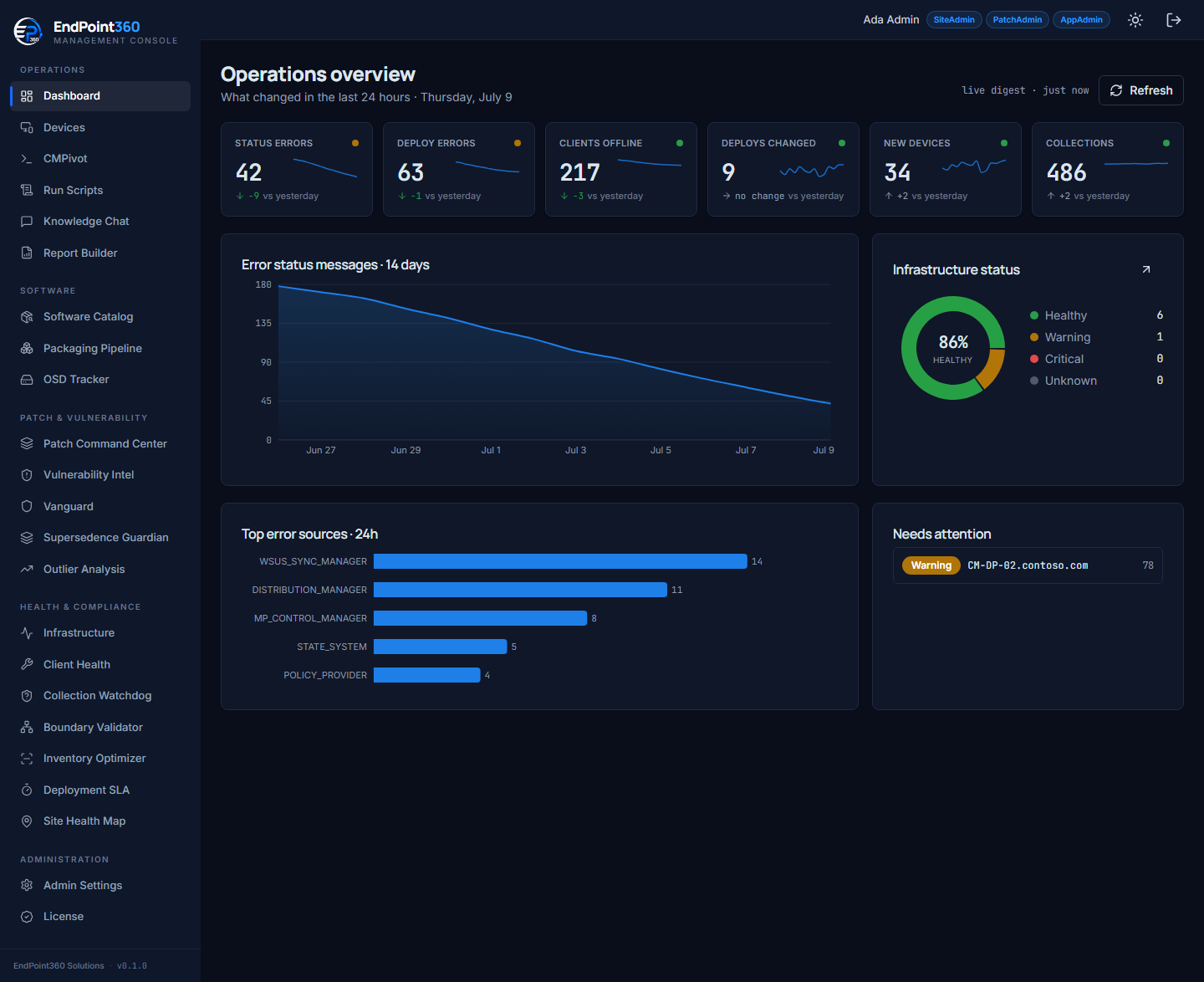
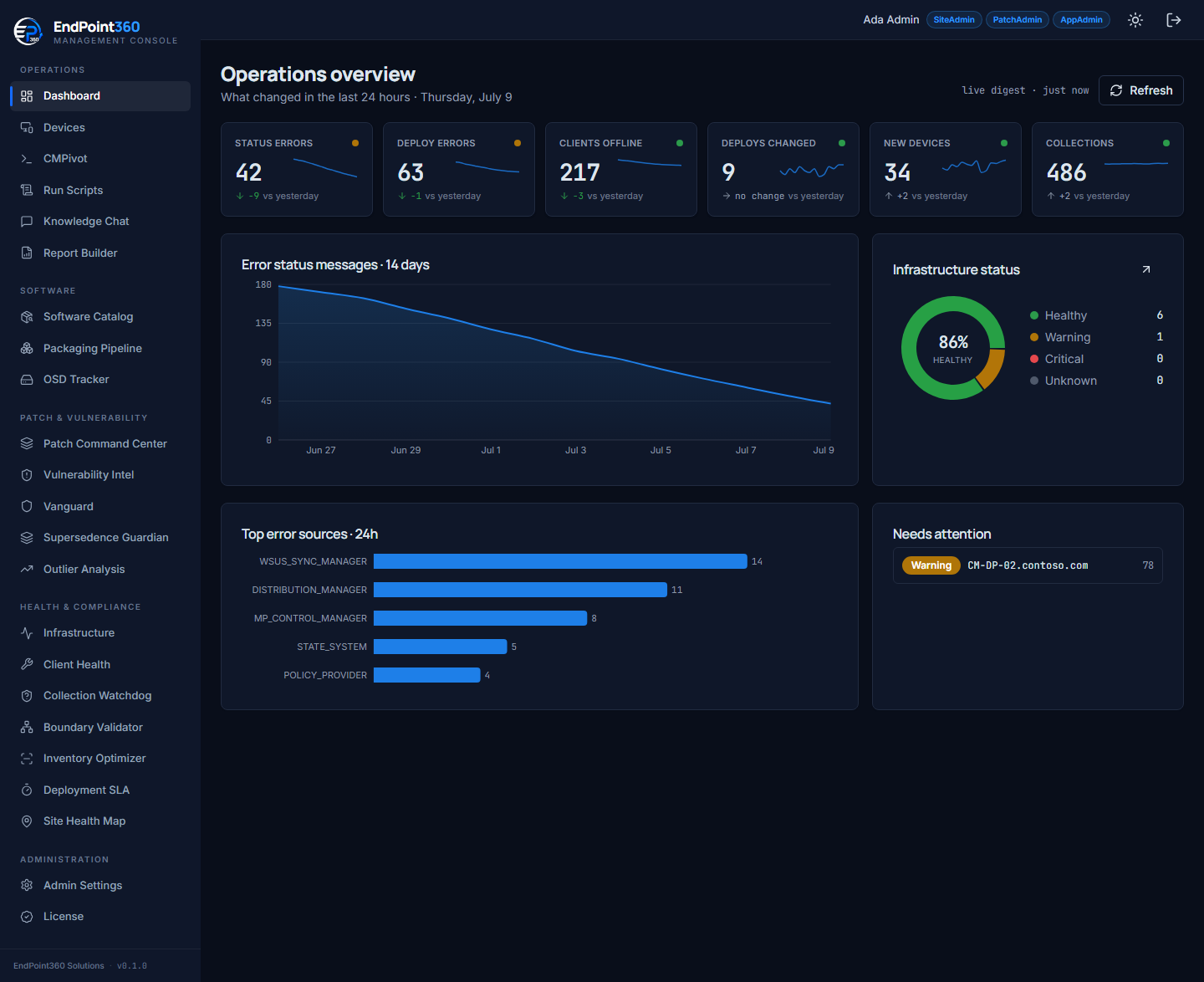
The morning briefing for your estate: what changed in the last 24 hours, error trends, infrastructure status, and what needs attention. The whole picture before your coffee is cold.
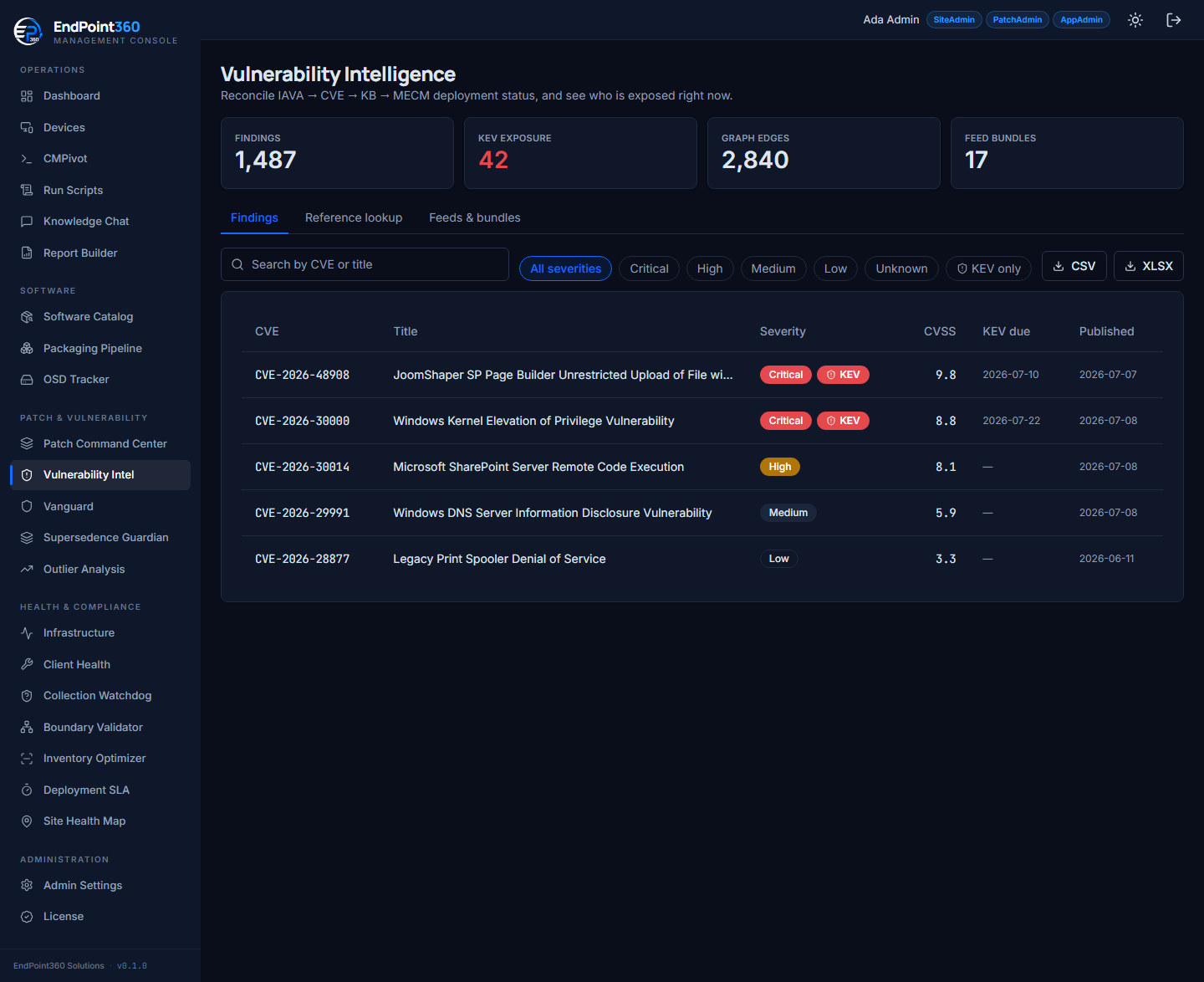
Reconcile threat feeds against what ConfigMgr has actually deployed. See every exposed device for a CVE or IAVA in seconds, with KEV due dates and CVSS front and center.
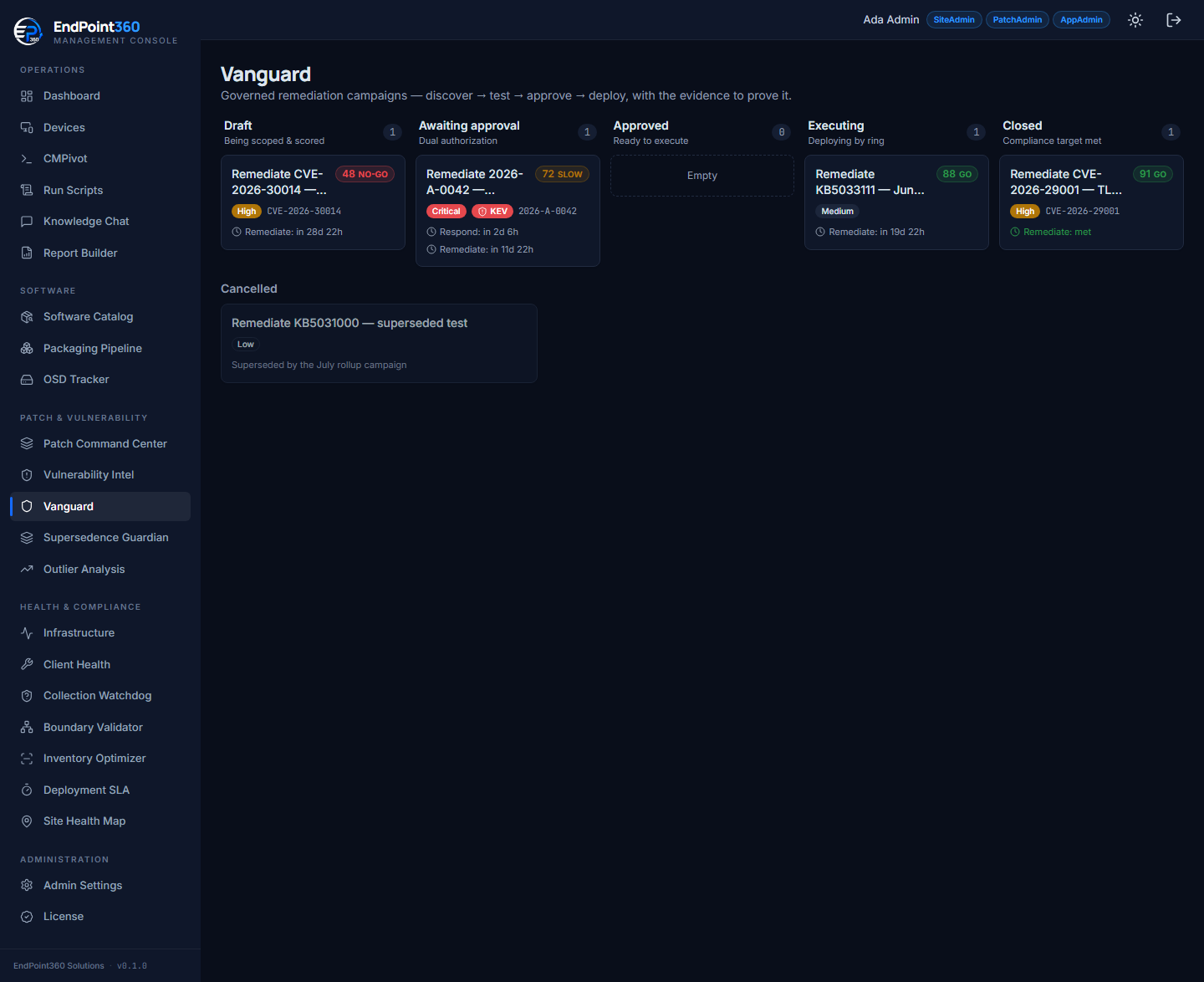
A campaign board that scores, deploys, promotes on evidence, and closes on measured compliance, with dual-authorization and a NIST 800-53 evidence trail written as it happens.
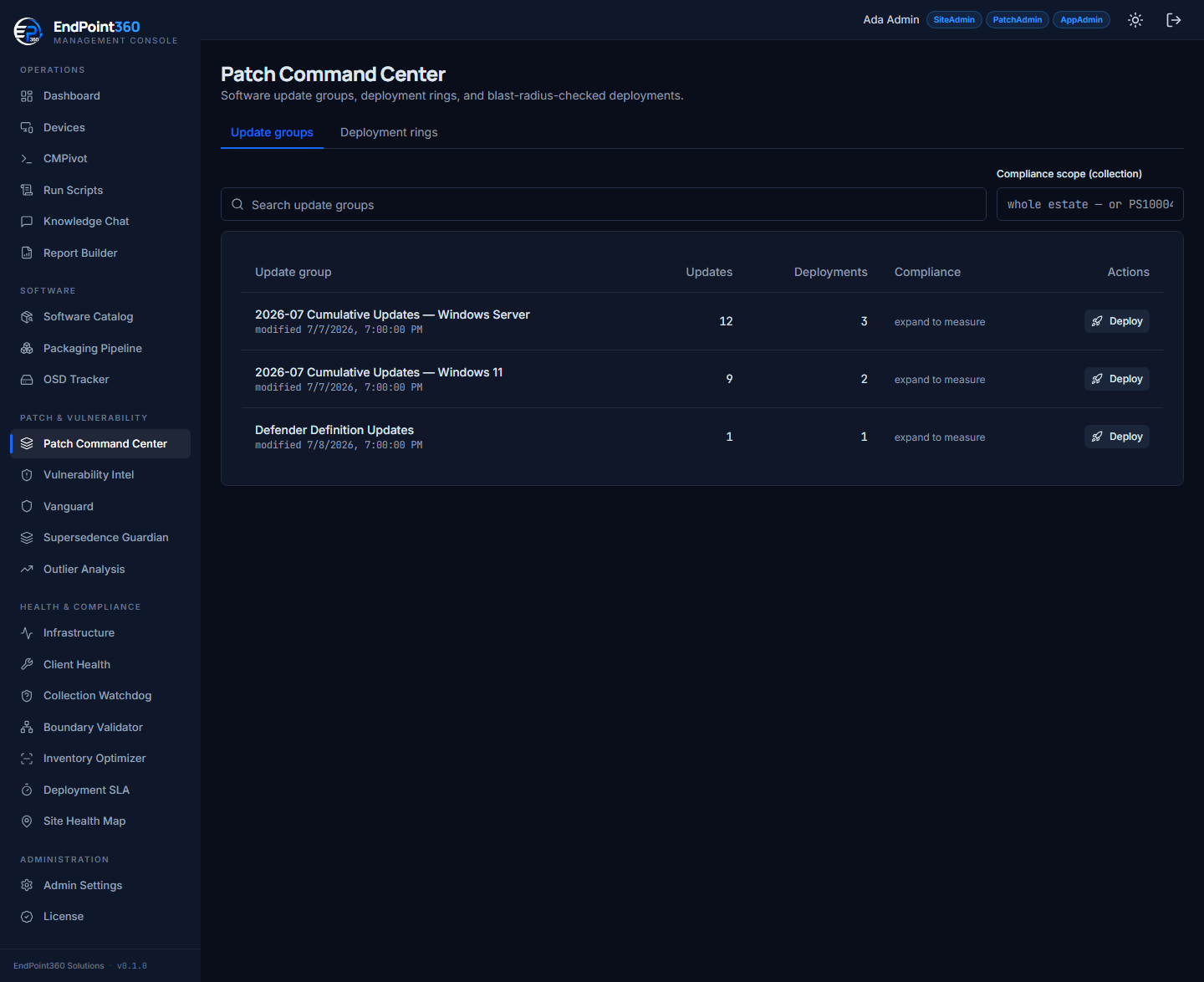
Compliance by software update group and collection, deployment rings at a glance, and a blast-radius preview that shows exactly what a deployment will touch, recorded as evidence before you commit.
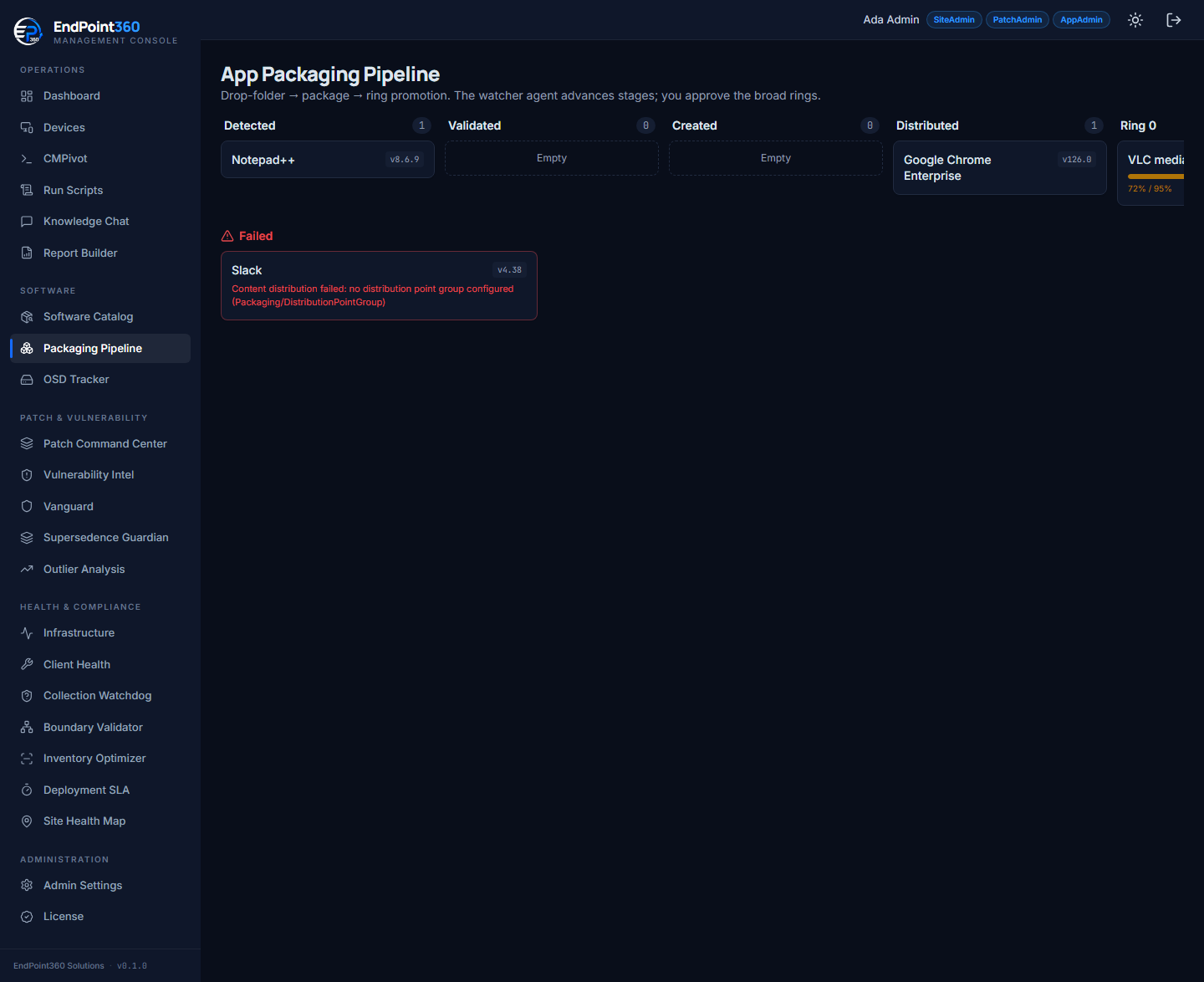
Drop a package in a folder; it validates, creates the app, distributes, deploys to a pilot ring, and auto-promotes on success, with an approval gate for the rings that need a human.
Find superseded and expired updates cluttering your groups and remediate in one click. Then cluster deployment failures by model, subnet, boundary, or DP to find the one signature behind a wave of tickets.
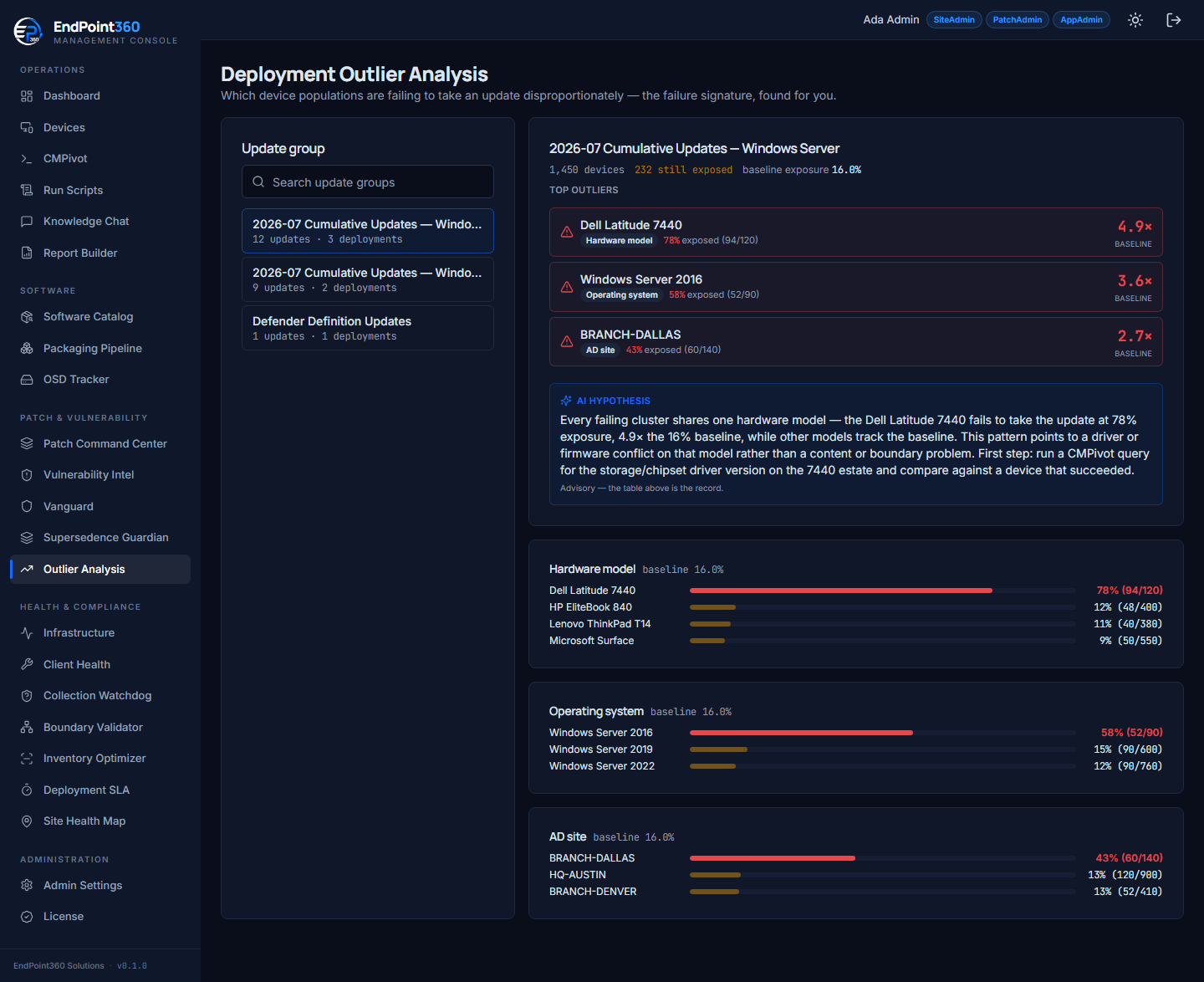
Watch task sequences move through their state messages in real time (which step, which device, which failure) instead of parsing SMSTS logs after the fact.
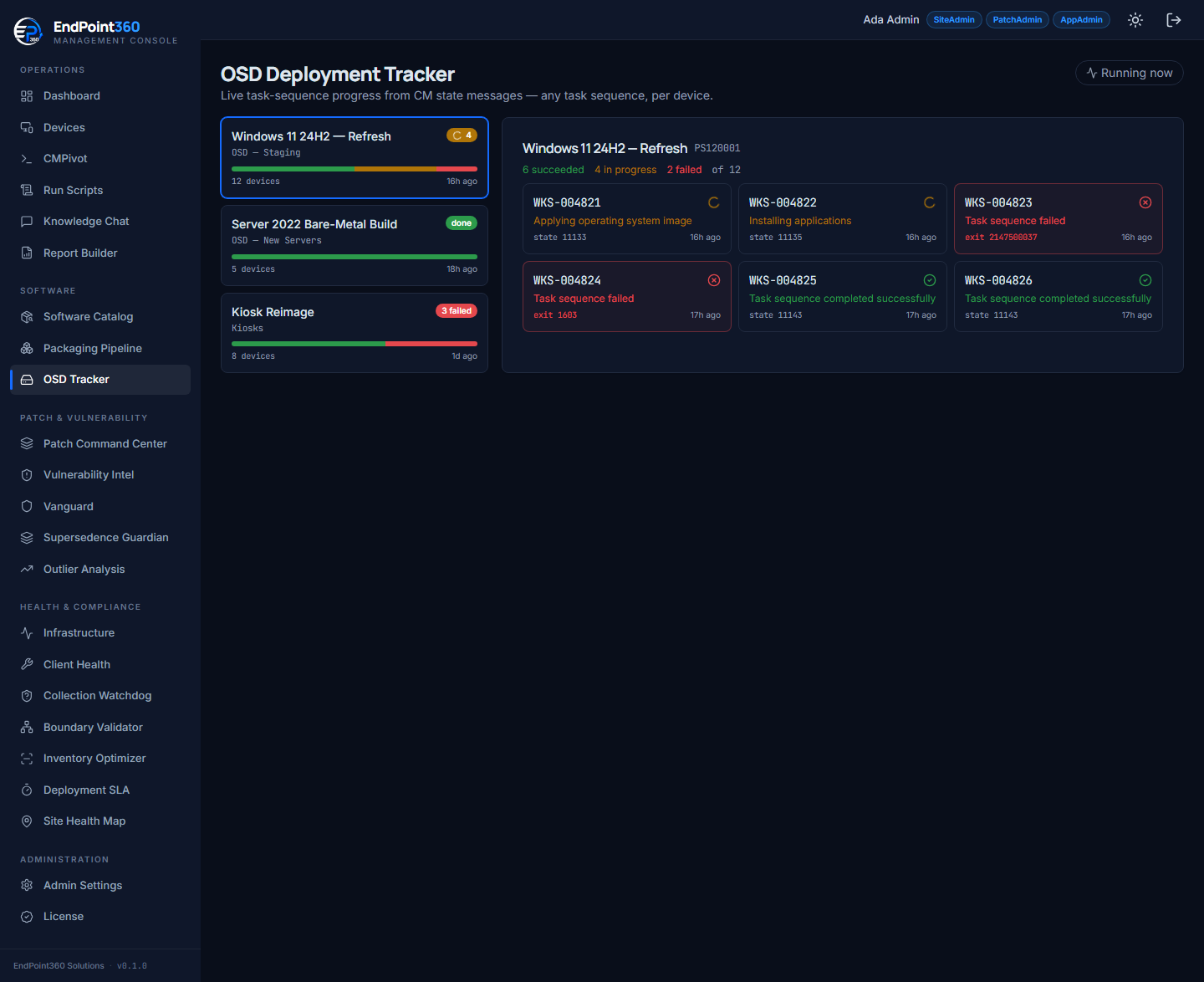
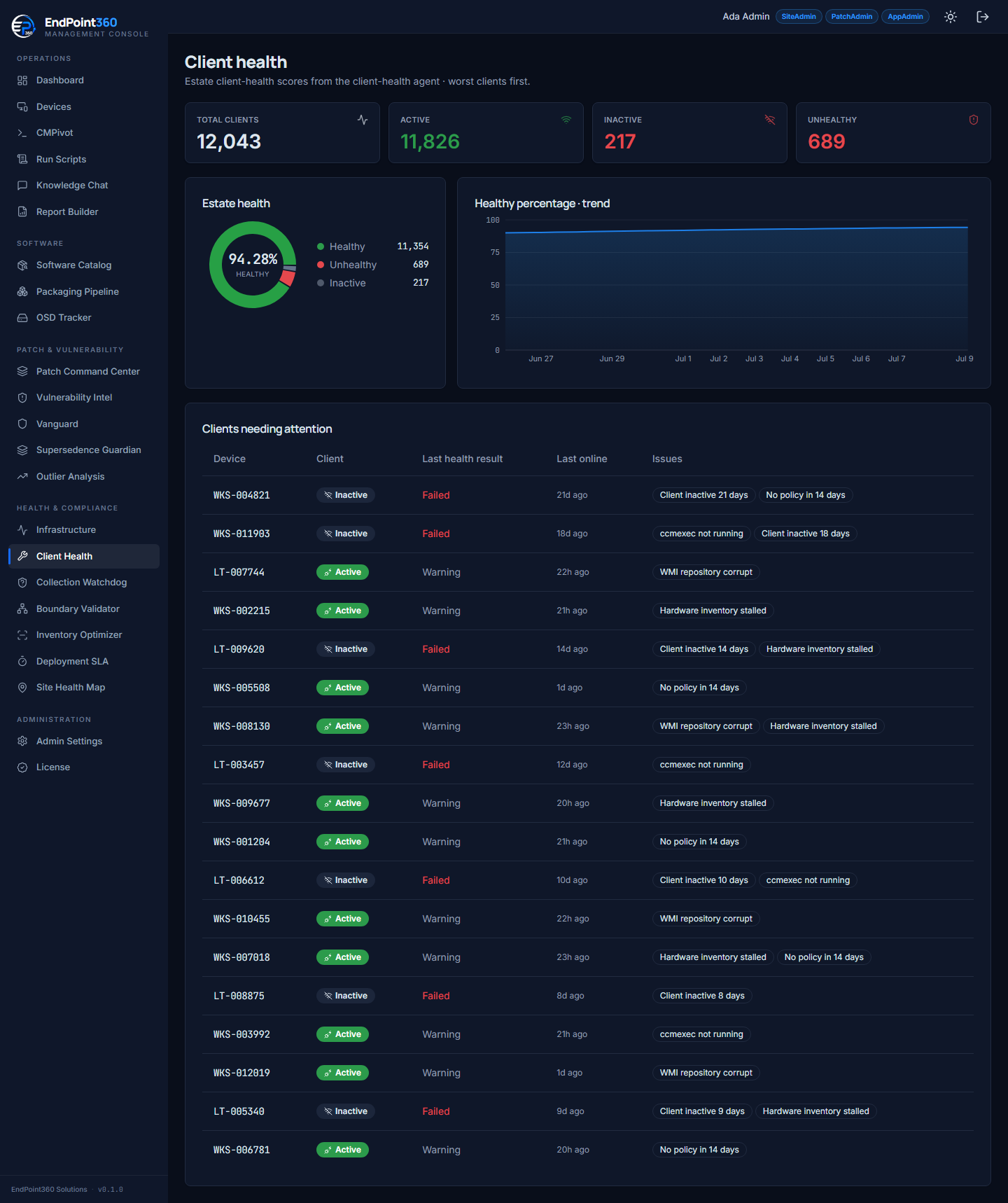
Estate-wide client-health scores, a healthy-percentage trend, and the worst clients first with their actual issues (WMI, ccmexec, inactive) so you fix causes, not symptoms.
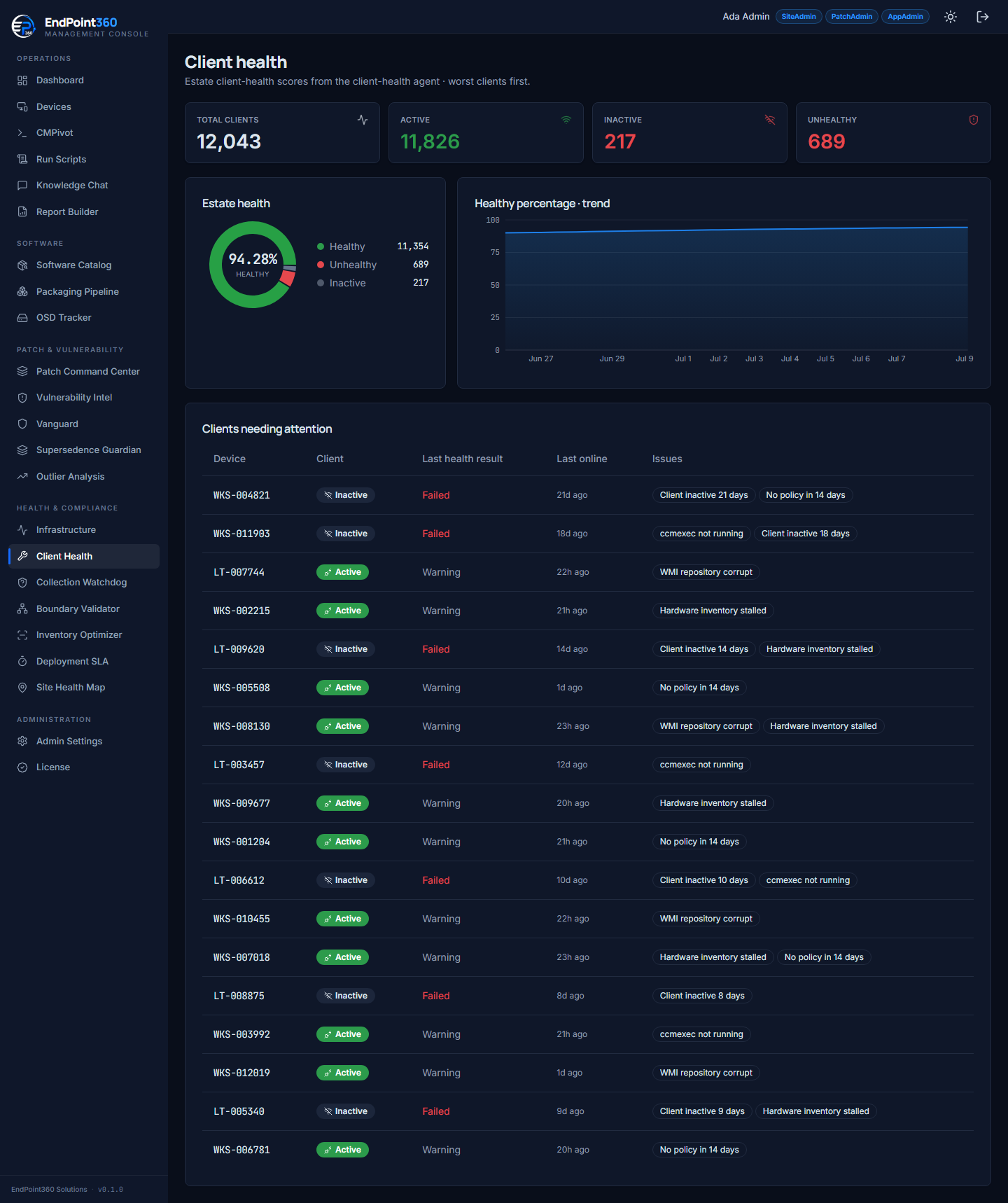
Overlapping and orphaned boundaries, clients outside any boundary group, distribution-point content status, and site-server health. The plumbing that quietly generates tickets, made visible.
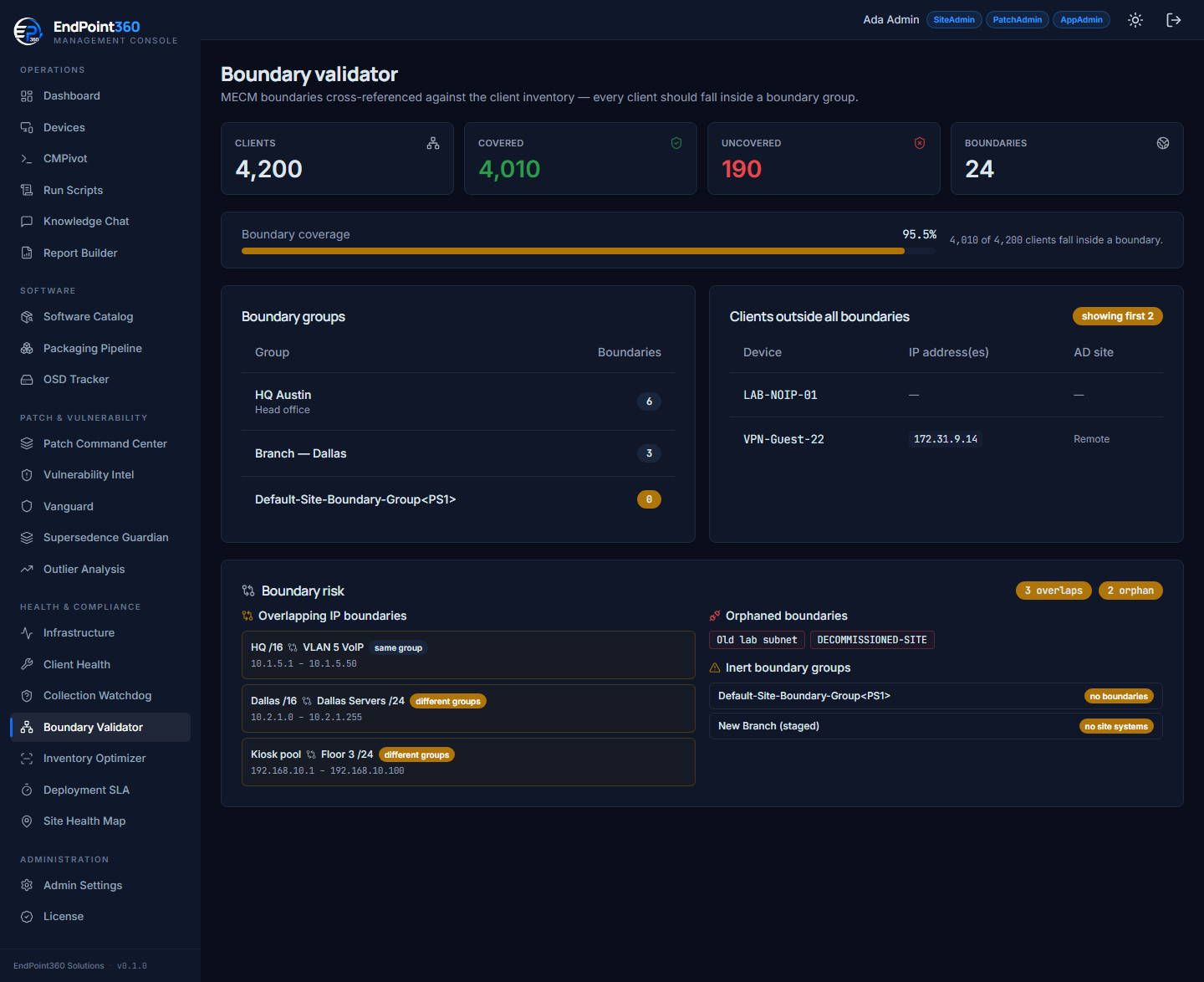
Plus Devices & Device 360, CMPivot and Run Scripts web consoles, Software Catalog, Collection Watchdog, Deployment SLA tracking, Knowledge Chat, the NLP report builder, and the Site Health Map. Every view ships dark and light, responsive to 375px, with real loading, empty, and error states.
The Enterprise edition ships five AI capabilities that work where AI usually can't. Every answer is grounded in your own site data, never a generic guess. And the whole layer is built for shops where "we ran it through a chatbot" fails the audit.
Plain-language questions about your environment, answered from your site database, your configuration, and the product docs, with the sources cited inline.
Background agents watch estate signals around the clock and turn a spike into a governed incident with an owner and an SLA clock, not a chart nobody opens.
Deployment failures cluster by model, driver, subnet, and DP. Then the AI names the signature in one sentence a human can act on.
Describe the report you need and get validated SQL against your site database. The safety layer fails closed: read-only, schema-checked, and audited, so the worst case is "no report," never "wrong data."
Campaign evidence compressed into the one page an approver actually reads: severity, exposure, confidence score, the weakest check, and the deadline math. The human decision, fully briefed.

Troy has worked with this product line for 28 years, starting with SMS 1.0 in 1998. He went on to support Configuration Manager at Microsoft itself, across every sector of government and a range of industry verticals, on some of the largest deployments in the world.
"I built this because I have watched too many ConfigMgr admins struggle with a product Microsoft moved on from. The investment went to the cloud and Intune, and now to Copilot, and none of that intelligence is coming back to an on-premises console. Meanwhile Intune has struggles of its own, and millions of endpoints still run on ConfigMgr and the admins who keep it going. So the purpose is simple: if Microsoft will not bring the intelligent, advanced features to this product, EndPoint360 will."
We are in it with the ConfigMgr admin heroes keeping systems management going. That is why Endpoint360 feels different: every feature started as a real ticket, a real Patch Tuesday, or a real audit question. Lean by design, no layers, no bloat, and support that talks to the engineer who built it, not a tier-1 script.
The console and Vanguard are in early access with our first Founding Design Partners. The rest is sequenced by real customer pull, not a marketing calendar. Nothing here is a prerequisite for the early-access cohort.
The full web console across all three editions, plus the AI layer and Vanguard Autopilot in Enterprise. In early access with our first Founding Design Partners.
A fast, modern self-service catalog for end users, replacing the aging Software Center experience. Its own lightweight service, curated from the console.
A restricted technician surface: find, fix, install on behalf of, and escalate a device with its evidence attached. Included with Professional.
The same cockpit for co-managed and cloud-managed estates. Built when co-managed shops pull for it.
We're selecting Founding Design Partners now, ahead of general availability: enterprise and government, connected or air-gapped. Whether your team says ConfigMgr, SCCM, or MECM, this is the console built for it.